Introduction
Raising curious, confident children in Omsk means blending everyday city life — walks along the Irtysh, visits to local libraries and playgrounds — with intentional learning at home. This guide gives age-specific activities, speech-development tips, creative ideas, emotional-intelligence strategies and practical resources you can use right away.
Where to look for local support in Omsk
— Public and children’s libraries — story hours, puppet shows, book collections for different ages.
— Municipal polyclinics and private *logoped* (логопед) centers — for speech checks and therapy.
— Community centers, early-development studios (*развивающие центры*) and parent groups — for playgroups and classes.
— Parks and riverfronts along the Irtysh — free outdoor learning and social play.
— Bookstores and online retailers (Ozon, LitRes) for Russian children’s literature and activity books.
Age-by-age practical plan (1–10 years)
Ages 1–2: Foundations — bonding, gestures, first words
— Speech & communication:
— Talk constantly about actions: *“Mама режет яблоко”*, narrate routines.
— Use simple repetition and short phrases (2–3 words).
— Read board books daily; point to pictures and name them.
— Games & activities:
— Sensory bins (rice, dried pasta) — supervised tactile exploration.
— Stacking cups, simple shape-sorters.
— Mirror play: make faces, name emotions — *“smile, sad”*.
— Creative & motor:
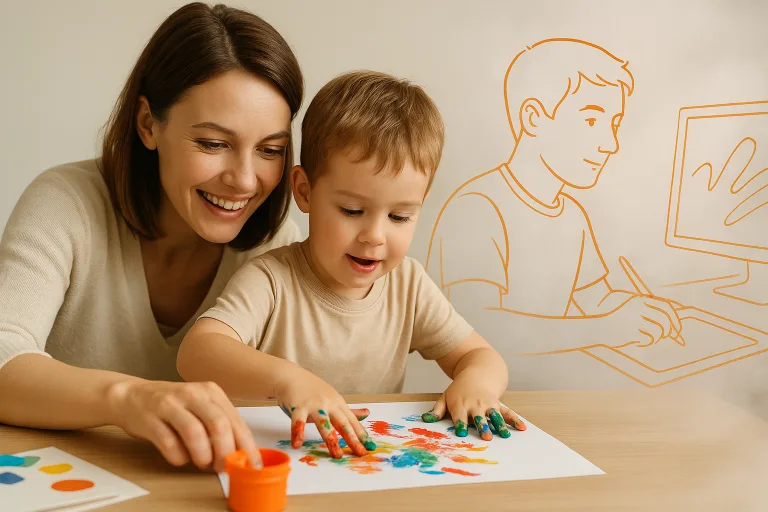
— Finger painting with edible paints; large crayons.
— Push–pull toys and short obstacle walks in parks.
— Emotional tips:
— Respond to every attempt at communication; this builds trust.
— Keep consistent routines: sleep, meals, playtimes.
Ages 3–4: Expanding language, imagination and social play
— Speech & communication:
— Nursery rhymes and short poems (Chukovsky, Marshak, Barto) — rhyme helps phonology.
— Ask open-ended but simple questions: *“Что случилось?” “Почему утёнок плачет?”*
— Games & activities:
— Pretend play sets (kitchen, doctor) to build vocabulary and role-taking.
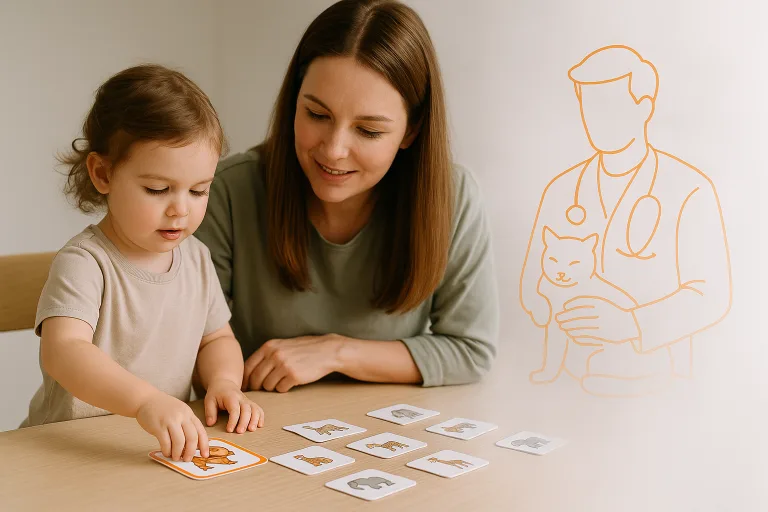
— Simple board games with turn-taking (matching games, lotto).
— Outdoor scavenger hunts in a park.
— Creative:
— Collages, stamping, playdough modelling — teach new verbs and adjectives as you go.
— Story-building: you start, child continues one sentence at a time.
— Emotional tips:
— Teach names of feelings (joy, anger, fear) and practice calming strategies (deep breaths, quiet corner).
— Encourage sharing with guided role-play and praise specific behaviour.
Ages 5–7: Early school years — literacy, reasoning and cooperation
— Speech & literacy:
— Daily storytime; ask prediction and comprehension questions.
— Play sound games: find words that start with the same sound.
— Educational games:
— Phonics games, simple puzzles, counting games with objects.
— Cooperative board games to teach rules, patience and winning/losing gracefully.
— Creative:
— Simple crafts from recyclable materials; small group projects encourage cooperation.
— Drawing stories and making a homemade “book.”
— Emotional & social:
— Role-play conflict resolution: label the feelings, suggest solutions, practice.
— Set small responsibilities at home to build competence and autonomy.
Ages 8–10: Critical thinking, creativity and empathy
— Cognitive & speech:
— Read chapter books together; discuss characters’ motives and feelings.
— Encourage presentations or short reports on favourite topics to build structured speech.
— Games & activities:
— Strategy board games (simplified chess, cooperative games), science kits, coding apps for kids.
— Creative writing prompts and group storytelling games.
— Creativity:
— Long-term projects: model-making, class newspaper, or a small garden patch in a balcony or community garden.
— Encourage peer-led clubs (art, robotics, reading).
— Emotional intelligence:
— Practice perspective-taking: *“How would you feel if…?”*
— Discuss media and peer pressure; role-play assertive communication.
Speech development—practical exercises you can do at home
— Repetition and modeling: repeat back correct forms naturally (“I: *apple*. Child: *ap-ble* — Good try! It’s *apple*.”)
— Minimal pairs game: choose words that differ by one sound (bat/pat) and play identification games.
— Slow and exaggerated speech for tricky sounds; use hand cues and mirrors for articulation practice.
— Rhyme and clap: clap syllables in words to build phonological awareness.
— Daily reading routine: 10–20 minutes for younger, 20–40